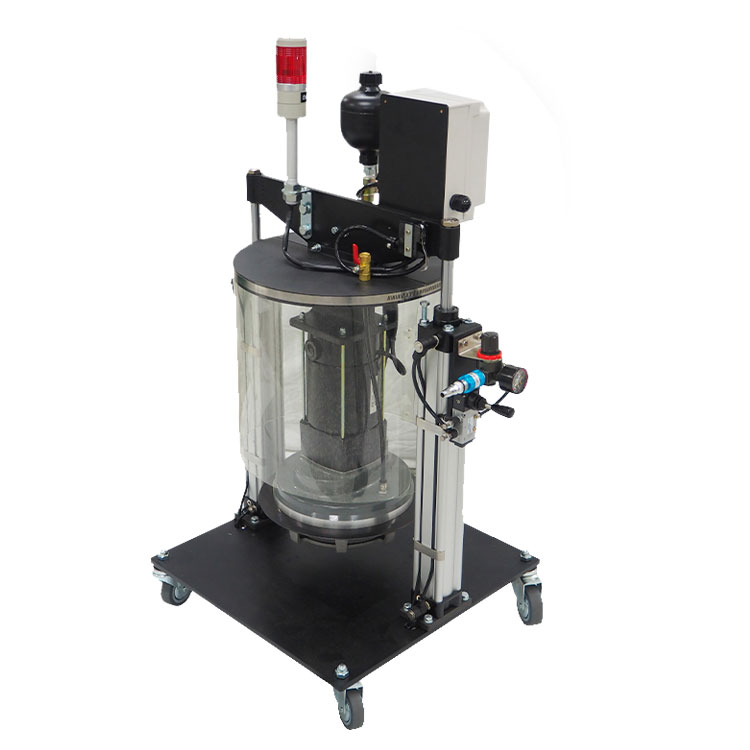
produit de presses électriques servo


The FAQ is regularly updated to reflect the latest information and to ensure that you have the most accurate details at your fingertips.
Thank you for choosing us, and we hope you find the answers you need!
- What is a servo linear actuator mechanism?
The servo motor is directly connected with the transmission screw of the electric cylinder, so that the encoder of the servo motor directly feeds back the displacement of the moving piston of the electric cylinder, which reduces the inertia and clearance of the intermediate link, and improves the control and control accuracy.
- How is a servo press machine different from a mechanical press machine?
A servo press machine differs from a mechanical press machine in that it employs a servo motor that provides precise control over the ram’s position and speed, while a mechanical press machine uses a flywheel and clutch to control the ram.
- What is the maintenance required for a servo press machine?
A servo press machine requires regular maintenance, including lubrication, checking for wear of components, and calibration of the servo motor. Regular maintenance ensures optimal performance and longevity of the machine.
- Who are we?
Our headquarters is located in Guangdong, China, and sells to Southeast Asia, Eastern Europe, Western Europe, North America, Northern Europe, Central America, South America, East Asia, South Asia, Oceania, Southern Europe, Africa, and the Middle East.
- What is Double Station Turntable Servo Riveting Machine?
The Double Station Rotary Table Servo Riveting Machine consists of a cast body, a double station rotary table, a servo riveting system, a human computer interaction system, and a safety protection system.
- Is the machine easy to clean?
Yes, most electric butter churners are designed with easy to clean parts. Simply disassemble, wash with warm soapy water, rinse and allow to dry.
- What is a Desktop Servo Riveting Machine?
Desktop Servo Riveting Machine are high-torque machines. They are able to produce the output pressing force with full energy at any point of an operation.
- What is a Nano silver sintering machine?
Our nanosilver sintering machine is an efficient and environment-friendly nanomaterial preparation equipment product, which focuses on the sintering preparation of high quality nanosilver powder. The product adopts advanced microwave heating technology to effectively control the temperature field distribution and ensure uniform and stable sintering process. Equipped with a sophisticated vacuum system and exhaust gas treatment device to ensure that the sintering process is carried out in a dust-free, low-oxygen environment, thereby improving the purity and dispersion of nanosilver powder.
- What is Motorcycle engine cradle servo press?
Manual auxiliary loading and unloading of the cradle, automatic loading of the bushing, automatic installation of the pivot tube rubber sleeve, and automatic pressure installation of the bushing.
The equipment mainly consists of: casting frame, automatic loading and unloading system, multi-station turntable, servo pressing system, human-computer interaction system, safety protection system and other parts.
- What is a servo press machine?
Guangdong pinjialing Intelligent Technology Co. , Ltd is a professional to servo pressing, Precision coating and Related Equipment R & D and manufacturing as one of the modern technology-based companies. Servo press machines consist of many components, including a servo motor, servo driver, lead screw, PLC, touch screen, timing pulley, timing belt, guide rod, bearings, power switch, and thermal protection.