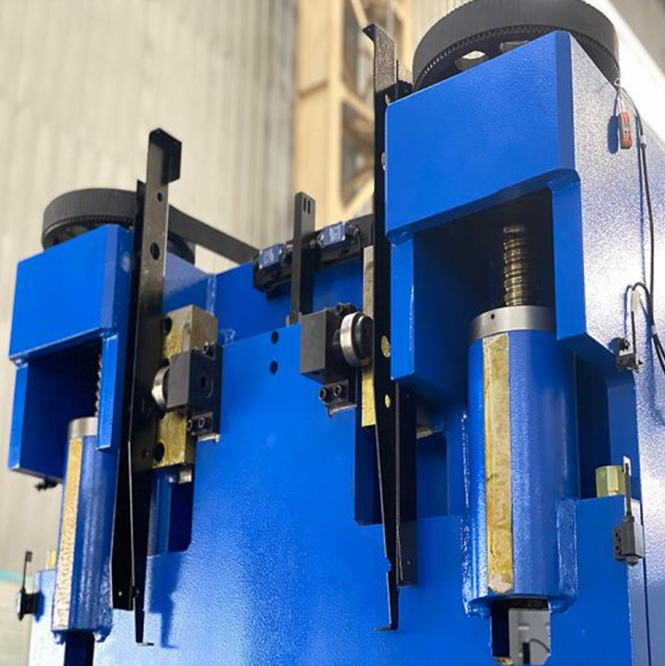
Technologie de servomoteurs dans les presses


The FAQ is regularly updated to reflect the latest information and to ensure that you have the most accurate details at your fingertips.
Thank you for choosing us, and we hope you find the answers you need!
- How is a servo press machine different from a mechanical press machine?
A servo press machine differs from a mechanical press machine in that it employs a servo motor that provides precise control over the ram’s position and speed, while a mechanical press machine uses a flywheel and clutch to control the ram.
- What types of materials can be formed using a servo press machine?
A servo press machine can be used to form a variety of materials, including steel, aluminium, copper, and other alloys.
- What is a Nano silver sintering machine?
Our nanosilver sintering machine is an efficient and environment-friendly nanomaterial preparation equipment product, which focuses on the sintering preparation of high quality nanosilver powder. The product adopts advanced microwave heating technology to effectively control the temperature field distribution and ensure uniform and stable sintering process. Equipped with a sophisticated vacuum system and exhaust gas treatment device to ensure that the sintering process is carried out in a dust-free, low-oxygen environment, thereby improving the purity and dispersion of nanosilver powder.
- What are the advantages of using a servo press machine?
The advantages of using a servo press machine include reduced production costs, increased productivity, improved product quality, and better energy efficiency.
- Which shipping way can you provide?
We can provide shipping by sea, by air, by express and etc according to customer requirements.
- What is the accuracy of the servo press?
Positioning accuracy: (mm) : ±0.01
Pressure Accuracy (%F.S): 0.5
Displacement resolution (mm) : 0.001
- What are the advantages of servo presses in forging?
In addition to making it possible to form materials traditionally considered difficult to machine, our servo presses offer a number of other benefits, including higher forming accuracy, increased productivity, reduced noise, and improved energy savings.
- How many types of riveting machines do we have in our factory?
Our factory has S / C type precision intelligent servo press equipment, high precision diameter riveting, pendulum riveting, servo rotary riveting machine.
- Is it safe to use?
Yes, the Electric Butter Machine is safe when used according to the manufacturer’s instructions. Always follow the safety guidelines and precautions outlined in the instruction manual.
- What is the use of Servo Riveting Machine?
Guangdong Pinjialing Intelligent Technology Co. Ltd. is a professional servo press, precision coating and related equipment R & D and manufacturing as one of the modern technology-based enterprises. Our servo riveting machine is used to automatically set (press) rivets to join materials together. The riveting machine offers greater consistency, productivity and lower cost compared to manual riveting.